
A used travel trailer is in many ways superior to a brand new trailer. You get to spend less and won’t have to bear the impact of high depreciation. And you can own one for as little as $5,000. While that figure may sound conservative, there are trailers available for you to purchase. Here, you’ll find ten used travel trailers under $5000 that you can buy in 2024.
You can find these models either online or at your nearest second-hand car dealership. The exact price may vary, but it’ll be around the five-thousand-dollar mark.
And if you want to test one out for an affordable price before making the investment – check out our RV rentals here.
Try It Before You Buy It – Travel Trailers For Rent Near You
Are Used Travel Trailers Worth it?
Many campers advise against buying a used travel trailer. While they have some valid points to make, buying a second-hand trailer does have benefits.
The first obvious benefit is the reduced cost. Used RVs and travel trailers are available at 50%, 60%, or even 90% less than the retail selling price. So if an RV costs $100,000, you can get your hands on it for $50,000 or even $20,000 from a reseller.
Thus, old camper trailers are an excellent choice for budget-focused recreationists.
Used travel trailers are also a better investment asset compared to newer ones. And that’s because of value depreciation.
A brand new RV, as soon as it leaves the retailer, loses some of its value almost immediately. By the end of the first year, it’d have lost 15-20% and around half by the fourth or fifth year. But after that, the value doesn’t depreciate as rapidly.
So if you happen to resell an old travel trailer down the road, you can expect a better deal than if you were selling a brand-new trailer. Obviously, this would depend on a lot of factors.
There are other benefits too, but these two are the primary reasons why people opt for pre-owned travel trailers.

What to Look for in a Used Travel Trailer
When buying a used trailer, prioritize checking the frame’s condition, plumbing, and electrical systems. Be sure to ask for maintenance records and any history of repairs.
It’s always important to check for any evidence of water damage, especially do the subfloor or any area underneath the trailer.
Whenever possible, have a qualified professional look over the entire unit. Also, ask that they run a pressure test on the gas lines to ensure safety when using propane.
Tips for Finding the Right Used Trailer
- Research Popular Models: Look for common models that maintain their value and are easy to repair.
- Inspect Thoroughly: Have the trailer inspected by a professional or bring a knowledgeable friend.
- Negotiate Prices: Always negotiate with sellers, especially if repairs or updates are needed.
Where to Buy Used Trailers Under $5000
Consider browsing classified ads, local dealerships, and online marketplaces. Popular sites like Craigslist, Facebook Marketplace, and RV Trader often feature used trailers at affordable prices.
Ten Used Travel Trailers Under $5000
Here are the ten used travel trailers under $5000:
- 2013 Palomino by Forest River
- 2011 Jayco Jay Feather Sport M-165
- 2011 Forest River RV Flagstaff High Wall HW29SC
- 1998 KZ Sportsmen 2303
- 2007 KZ Sportsmen Coyote Sport M-CS160
- 2013 Sportsmen Classic Series M-13FK
- 2010 Forest River Wildwood X-LITE 26BHXL
- 2011 Cherokee Wolf Pup Series M-16P by Forest River
- 2008 Heartland Cyclone 4012
- 2007 Keystone Laredo 26RK
2013 Palomino by Forest River M-131RL
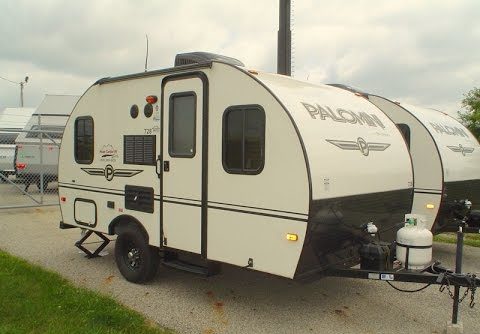
- Class – Fifth wheel
- Length – 16.8 ft
- Sleeps – Three to four campers
- Construction – Fiberglass
- Lowest Retail Price – $5,450
The 2013 M-131RL (or earlier) is among the best models you can find in this price range.
This model was designed to compete with pop-up campers. Thus, it has got rigid walls and a sturdy body.
Inside, you’ll find two dinettes at either end that can transform into beds. In the middle, there’s a kitchenette with a stovetop and sink, as well as a small refrigerator and an oven. You have an air conditioner on the roof, which is great for summer camping.
The travel trailer weighs less than 3,000 pounds, thus delivering better fuel efficiency.
It has a 7-way plug to allow you to control the lights and other equipment from the truck. With both 30-amps and 50-amp adapters available, you can camp at most RV campgrounds with this trailer.
On the outside, you’ll find a 120-pound LP bottle at the front, a furnace on the side, and an outdoor shower with a hose next to it. The shower is great to have if you’re coming from the beach and covered in sand. The powerful hose will help you get rid of the layer of sand. You can also use it to clean just about anything.
The fifth wheel is now discontinued. But it is still sought after by many RVers who appreciate its compactness and design.
2011 Jayco Jay Feather Sport M-165
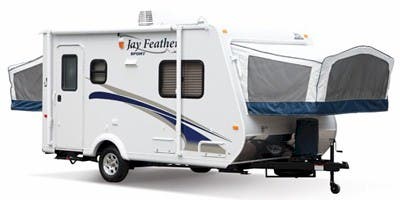
- Class – Fifth wheel
- Length – 18 feet
- Sleeps – Five campers
- Construction – Fiberwalls
- Lowest Retail Price – $6,600
When the Jayco Jay Feather Sport M-165 came out in 2011, it was an instant hit. It is sized decently and has a nice floorplan. It had more amenities than many other travel trailers in the same price bracket.
At 18 feet, the Jayco Sport M-165 is quite compact, but the amenities are on par with bigger trailers. It is among the few travel trailers in the $5,000-$6,000 range that has a bathroom with a shower and toilet.
Other amenities you will find inside are a compact dinette and a small kitchen area with a cooktop, a microwave, and a refrigerator. It also has a TV shelf and storage compartments along the walls.
The outdoors has a 10-feet patio awning to create shaded areas at the campsite. Other features are a small storage unit and a propane tank.
This travel trailer is ideal if you are looking for a decent amount of comfort and are flexible with size and weight.
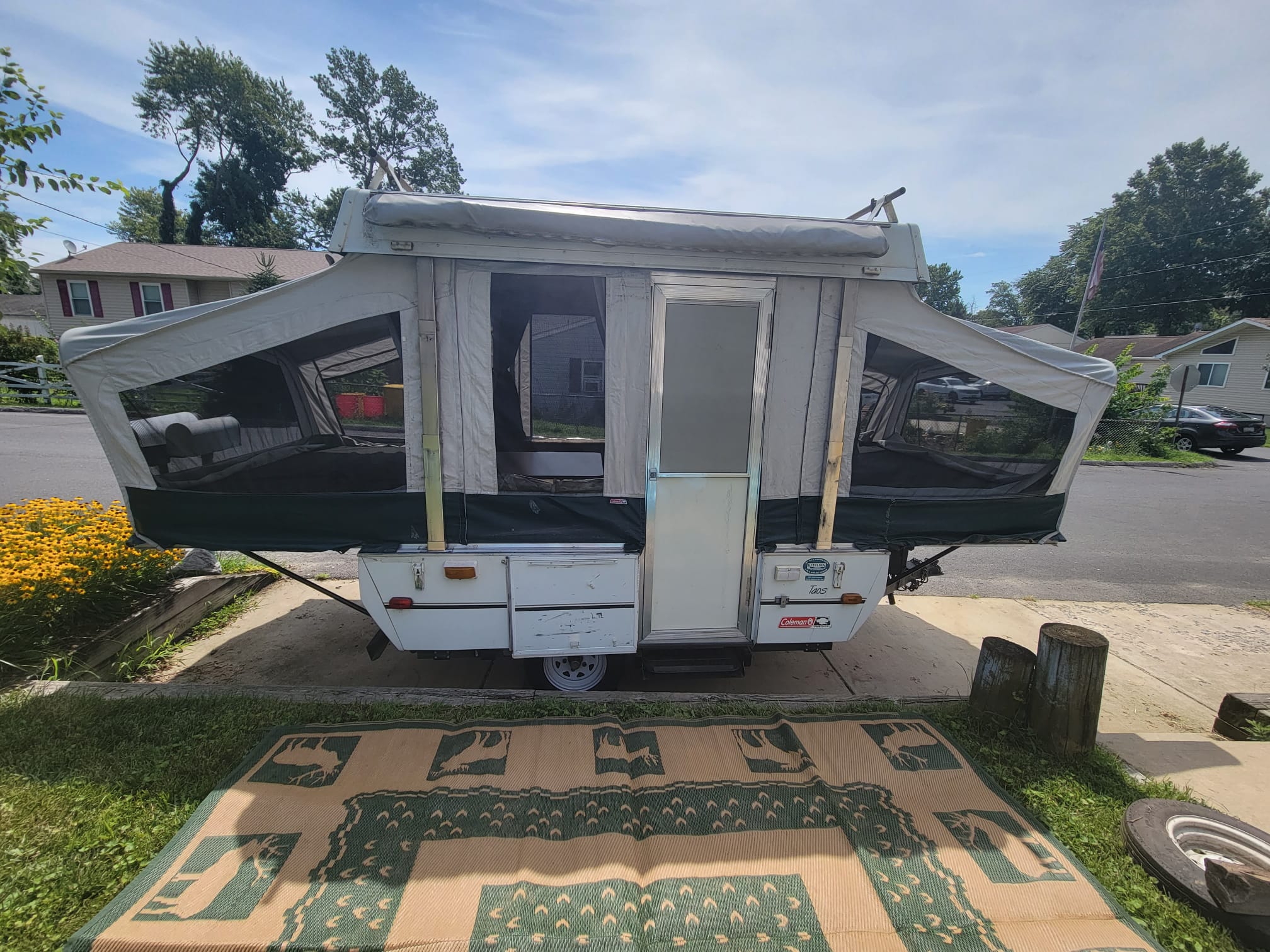
2011 Forest River RV Flagstaff High Wall HW29SC
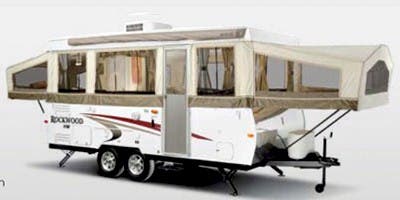
- Class – Pop-up folding camper trailer
- Length – 21-feet
- Sleeps – Five to six campers
- Construction – Canvas walls
- Lowest Retail Price – $4,000
The Forest River Flagstaff High Wall HW29SC is perhaps the cheapest travel trailer you’ll find for yourself. With pop-up walls and double slide-outs, it’s both compact and lightweight. So you can easily tow it with most pick-up vans and trucks.
What’s interesting about this camper trailer is it can accommodate five to six people with ease. There are two slide-out beds and a U-dinette that converts into a small bed. Along with that, there’s a sofa where one person can comfortably sleep.
Other amenities inside the trailer are a toilet, a kitchenette, a microwave, and a refrigerator. Also, there are two propane-filled cylinders that last longer than a single cylinder.
An outdoor griddle is in place to help you barbecue under the 13-feet awning.
River Forest is an RV, cargo trailers, and pontoon boat manufacturing company backed by Berkshire Hathaway. Their products are known for superior quality and durability. So you’ll still find the used trailers in good condition.
The company is still producing HW29SC campers in 2022. So there’s a good chance you’ll get genuine spare parts if needed.
1998 KZ Sportsmen 2303
- Class – Fifth trailer
- Length – 24.11 feet
- Sleeps – Five to six campers
- Construction – Fiberglass
- Lowest Retail Price – $5,995
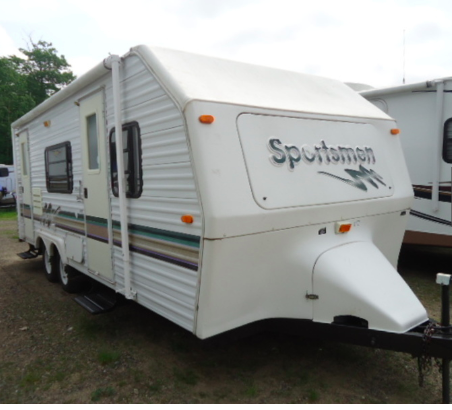
The Sportsmen 2303 from KZ has been around for more than two decades. Known for its spacious floor plan and lightweight design, it has been a favorite among many RVers. Depending on the production year, you may be able to get one of these used trailers for under $5000.
The Sportsmen 2303 features two doors, which is unheard of these days. Towards the front door, you have a queen-sized bed and TV panels. And the second door is towards the end near the kitchen. The kitchen space has a refrigerator, stovetop, and microwave.
You’ll also find a toilet, a dinette, and a slide-out sofa that can serve as a full-size bed. Besides that, there’s plenty of space and headroom to move around freely.
The Sportsmen 2303 comes with a 17-feet awning that provides shade for both doors. The awning also has LED lights that work wonders during the night hours. For outdoor parties, you’ll have two high-quality speakers on the outside.
Because of its vintage design, this classic travel trailer is still in high demand. The newer models built after 2005 may cost more, but they’re well worth the price.
2007 KZ Sportsmen Coyote Sport M-CS160

- Class – Travel trailer
- Length – 19 feet
- Sleeps – Five campers
- Construction – Fiberglass
- Lowest Retail Price – $5,500
The Coyote Sport is a smaller version of Sportsmen 2303. Unlike the previous model, it has only one entrance door, but the amenities are more or less the same.
The trailer is equipped with a lower double bed and a bunk bed. Together these can sleep three campers with ease. At the opposite end, there’s a U-shaped dinette that is convertible and can be used as a bed.
The bathroom is retained as well, and it’s tucked in one corner. Along with that, you’ll find a pantry, a kitchenette, and overhead storage cabinets.
As a bonus, Coyote Sport M-CS160 has air conditioning and a furnace, making it an all-season travel trailer.
The trailer camper has a decent ground clearance, which allows you to tow it to secluded places, away from paved roads. Dual stabilizer jacks will make your job easier. But note that it’s not designed for off-roading.
Weighing just over 3,500 lbs, it isn’t too heavy either. So you’ll have an easy time handling the M-CS160.
KZ is an award-winning company; you can expect this travel trailer to be in good shape for a few more years.
Try It Before You Buy It – Travel Trailers For Rent Near You
2013 Sportsmen Classic Series M-13FK
- Class – Travel trailer
- Length – 14 feet
- Sleeps – Two campers
- Construction – Fiberglass
- Lowest Retail Price – $5,500
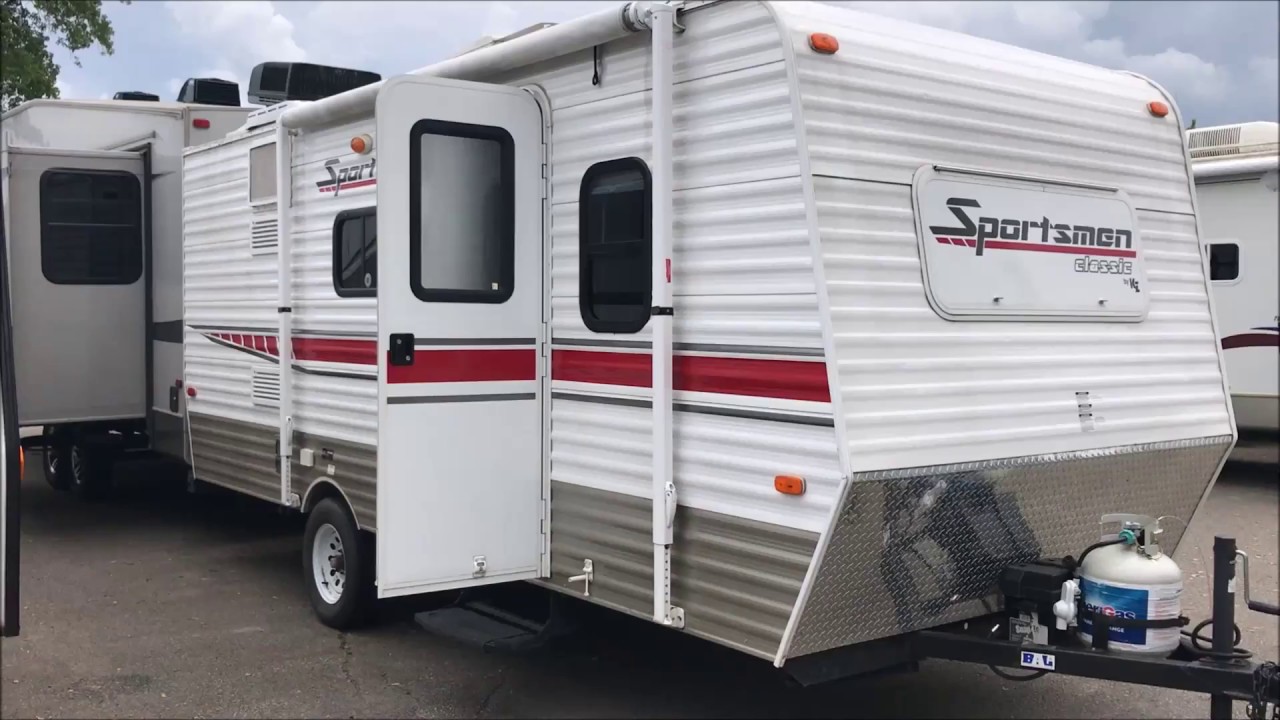
M-13FK is the third KZ travel trailer on this list. And it happens to be the smallest of them all, which translates to better maneuverability and fuel efficiency.
This travel trailer is designed for two campers. Inside this compact trailer, there’s only a dinette that converts into a bed. Also, you’ll find a closet, a refrigerator, and a stovetop. Despite the space limitations, KZ has managed to fit in a toilet with vinyl flooring.
Other amenities you’ll have with the M-13FK are an air conditioner, a 16,000 BTU heater, and indoor LED lights.
As opposed to other models, the M-13FK is a bit tough to find. Not many campers put these up for sale. But when they do, you can expect to purchase it for around $5,000 or more, depending on the trailer’s condition.
2010 Forest River Wildwood X-LITE 26BHXL
- Class – Travel trailer
- Length – 27 feet
- Sleeps – Six campers
- Construction – Fiberglass
- Lowest Retail Price – $4,500
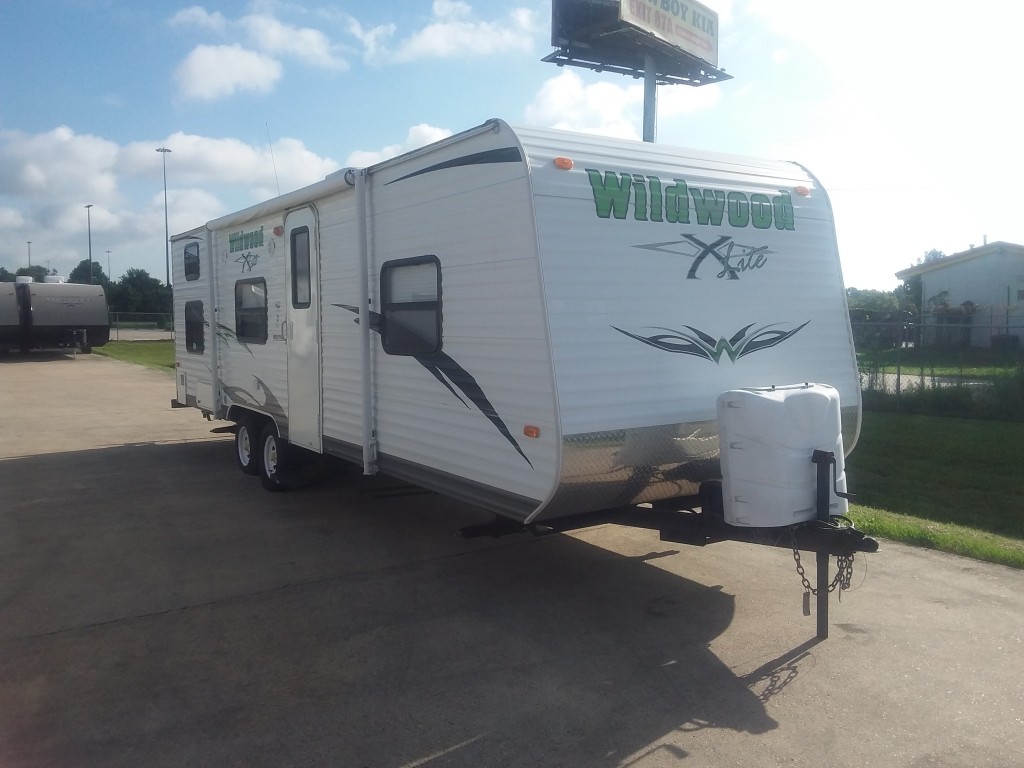
The Wildwood X-LITE 26BHXL is a family-friendly travel trailer that can easily make room for six members. This spacious trailer is everything you wish to have on a family camping trip.
Starting from the front, you’ll find a queen-sized bed with drawers and storage compartments next to it. Tinted windows on both sides provide an on-the-go viewing experience while offering much-needed privacy.
In the middle, you have a sofa that can be converted into a bed. The same goes for the dinette. Lastly, you’ve got a double bed at the rear that sleeps two campers.
The X-LITE 26BHXL also has an impressive dry bathroom with a shower, a tub, and a toilet.
To help you prepare meals on-demand, there’s a kitchenette with a mini-refrigerator, microwave, cooktops, and a sink. There’s plenty of space under the cabinet to store groceries and kitchenware. You can also prepare the meals outdoors as there’s an optional gas grill.
The travel trailer is a bit large and bulky at 4151 lbs. But if you’re looking for a spacious pre-owned trailer under $5,000, this is your best bet.
2011 Cherokee Wolf Pup Series M-16P by Forest River
- Class – Travel trailer
- Length – 17.9 feet
- Sleeps – Seven campers
- Construction – Fiberglass
- Lowest Retail Price – $6,800
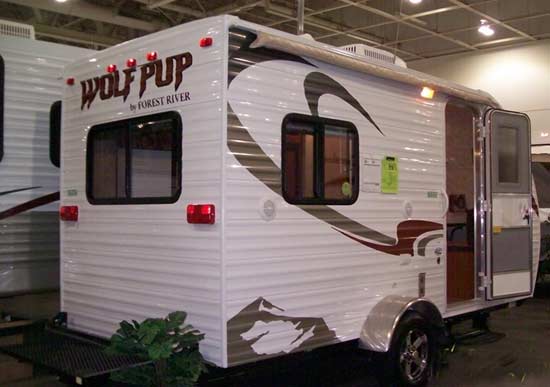
The Wolf Pup travel trailers aren’t known for being massive, but they do an incredible job of cramming various amenities into tight spaces. At 17.9 feet and 2654 lbs, the M-16P is among the most compact trailers in its category. But it isn’t short on amenities.
The M-16P Wolf Pup has a bunk bed. The bottom bed measures 44 inches, while the top bed measures 28 inches. Next to it is a wet bath with a shower and toilet.
As you go deep into the trailer, there’s a refrigerator with a kitchenette in front. Lastly, there’s a dinette set at the rear that you can convert into a bed. Some of the trailers also come with air conditioning and a heater.
Besides the above amenities, you have quite some space left inside the travel trailer to accommodate other optional amenities.
The exterior of Wolf Pup Series M-16P has some storage compartments and the standard 14-feet patio awning.
Forest River is still producing Cherokees in 2022. This does help in getting genuine spare parts for the trailer and customer support as and when needed.
Try It Before You Buy It – Travel Trailers For Rent Near You
2008 Heartland Cyclone 4012
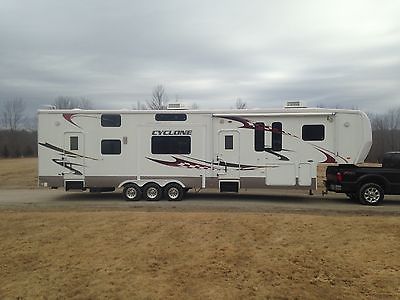
- Class – Fifth wheel
- Length – 40 feet
- Sleeps – Five campers
- Construction – Fiberglass
- Lowest Retail Price – $4,500
The Cyclone 4012 was designed to cater to the luxury RV segment. With three sides and two entry/exit doors, it is sure to give you a spacious and comfortable motor-camping experience.
The travel trailer starts with an over-cab that contains a queen-sized bed, a television, a dressing table, and storage racks. This section has a slide-out and you can move the bed outwards to create more space.
Close to the bed is a dry bathroom that is both spacious and well-equipped. It has a sink, shower, toilet, mirrors, and storage space. Then, you have the kitchen space that consists of a pantry, cooktop, sink, and refrigerator.
In the middle, Cyclone 4012 has a U-shaped dinette and a sofa set. Both of these have slide-outs and can be extended outwards. In the rear, there is another bed and an overhead loft.
All in all, it’s quite roomy with enough space for five campers.
Just like the interiors, the tanks (clean, black, and gray) are large as well. This makes Cyclone 4012 ideal for long-term camping or boondocking. Because it’s an upscale travel trailer, the newer models may cost more.
2007 Keystone Laredo 26RK
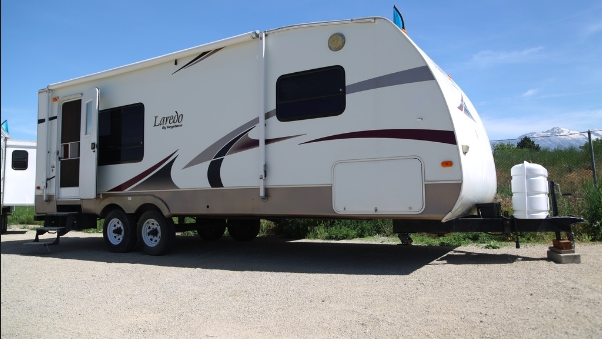
- Class – Fifth wheel
- Length – 26 feet
- Sleeps – Six campers
- Construction – Fiberglass
- Lowest Retail Price – $5,500
Laredo 26RK is a mid-size travel trailer with an impressive floor plan and a good range of amenities.
The 26 X 8 feet trailer has a rear-side entry. Near the entrance, you’ll find the pantry and the kitchenette that runs the width of the trailer. The kitchen space is equipped with cooktops and a microwave to help you prepare the meals.
The adjacent space is occupied by a small refrigerator, a slide-out sofa, and a storage cabinet. At the campground, you can extend the slide-out to create more space. In front of the sofa, you’ll find the LCD TV and the dinette area.
Next, you have got a dry bathroom with a separate toilet and shower. It’s also equipped with a sink and a small cabinet for storage.
Lastly, you can find the queen-sized bed in the over-cab section.
The 26RK can accommodate as many as six campers along with any pets you may have. You can use it for boondocking or dry camping since it’s a self-contained travel trailer.
The Keystone Laredo 26RK was priced at an MSRP of $27,907. It’d be a bargain if you secured this spacious trailer for $5,000 or less.
Things to Look for in a Used Travel Trailer
Buying a used travel trailer is good, but it certainly isn’t easy. It involves a lot of work and due diligence. Otherwise, you could end up with a lemon.
There are many things to inspect in a pre-owned trailer to determine its quality. But there are a few that hold more importance than others. These are:
Water damage
Water leakages are a common issue among RVs as they age. These can occur from the roof, the floor, under the windows, or through the pipes under the sink cabinet. Irrespective of the origin, leaks can significantly corrode the travel trailer.
Therefore, the first thing you should check is for these water leakages. Molds, brown spots, and wet surfaces are clear signs of a leaky camper.
Ask the previous owner regarding the water repair work he has done over the years. Then take necessary measures to fix the leaks.
Gas and plumbing
Next, shift your focus to the gas and plumbing section of the travel trailer. These should ideally be in good condition as well.
First, inspect the galley sink and the cabinet under it that houses the pipes. Make sure there are no leaks. Then, look for leaks in other components like the faucet and freshwater tank hose.
Likewise, go over the propane tanks and make sure they meet the criteria laid out by the National Fire Protection Association (NFSA). Also, it’s mandatory to get the tanks checked and certified before the sale.
Electrical system
The electrical systems of a camper vehicle are built around a battery. Therefore, ensure the battery, along with other major components like the alternator, smart relay charger, cut-off switch, battery monitor, and fuse, do not require significant repairs.
If the travel trailer has electrical solar panels, it would call for additional inspection work.
Air conditioning and heater
The sellers will charge a premium if the trailer has air conditioning and a furnace (which most in this list do). This is especially true if these features were not part of the standard package.
Therefore, you need to make sure you’re getting the right value for the premium price.
Sit inside the trailer and regulate the temperature first with the AC and then with the heater. It’s worth checking the power consumption as well during the process.
Papers and documents
Last but not least, check that the papers for the travel trailers are in order. This includes purchase receipts, repair receipts, insurance papers, and certifications, among other things. Make sure the owner’s claims sync with the documents in hand.
Conclusion
But before you buy a used RV, you should know about the so-called ‘Ten-year rule.’ It’s a rule that some RV parks, especially the upscale ones, follow whereby they restrict the RVs and travel trailers that are older than ten years. In other words, they deny service and camping sites to a decade-old RV.
Therefore, before visiting an RV park, you should find out whether they follow the ten-year rule.
Don’t want that hassle? Why not consider renting a travel trailer instead? At Outdoorsy, you’ll find a wide range of RVs at affordable rates. Rent them for a week or a month and pay as you go with no long-term commitments!